
Items and stock levels
An item is anything you stock and consume — a spare part, a consumable, a tool. Each item has one record (catalogue entry) that’s shared across all your worksites, but stock levels are tracked per worksite.
The item record
Open Procurement → Inventory and click any item.
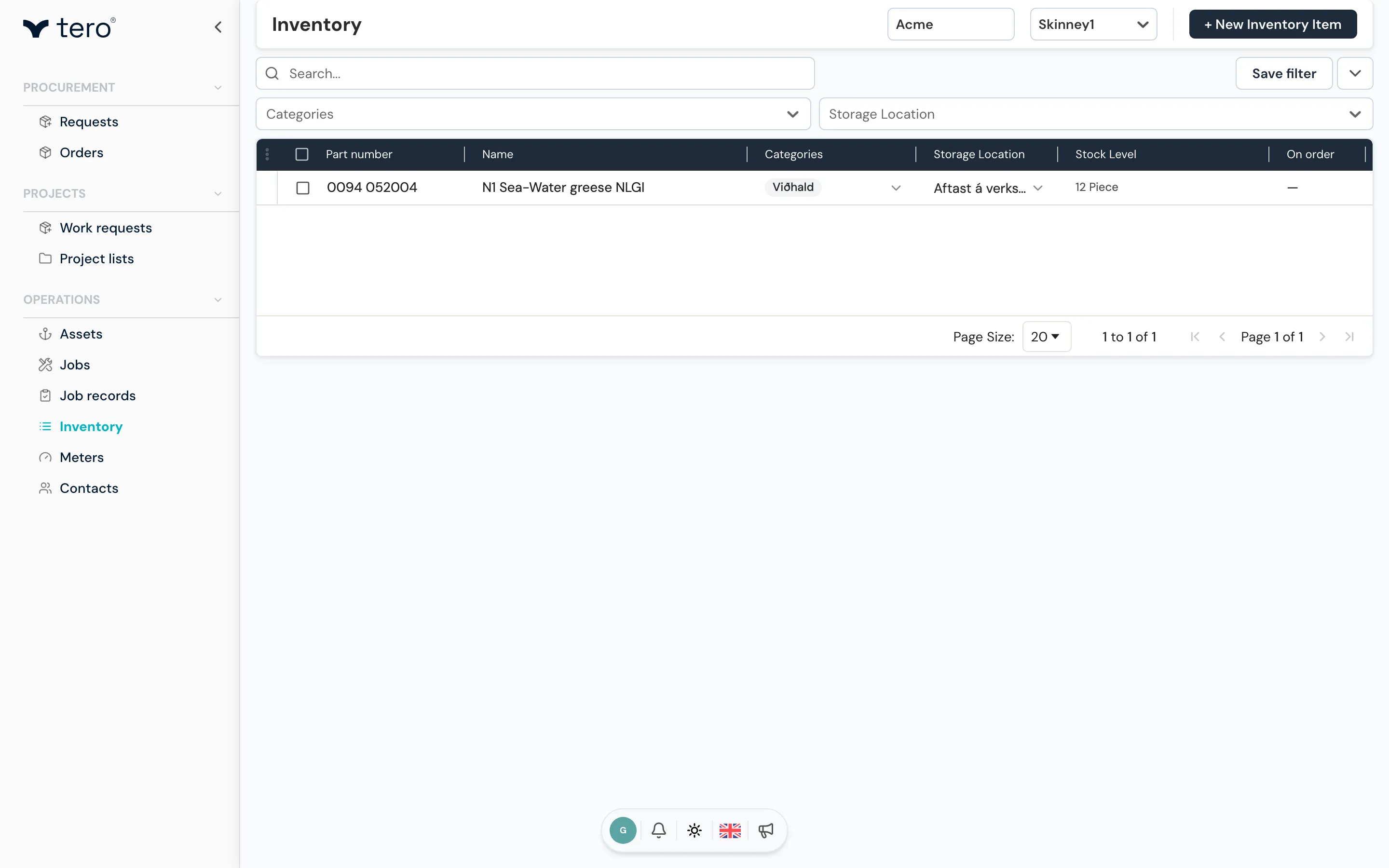
Fields on the catalogue record:
- Item name and part number
- Item description
- Categories (for filtering and bulk operations)
- Manufacturer
- Unit of measure (each, m, kg, L, etc.)
- Storage location (default location for new stock)
Stock levels per worksite
The Stock panel shows current stock at every worksite where this item is held.
For each worksite you see:
- Current stock — what’s actually on hand
- On order — what’s been ordered but not yet received
- Minimum stock level — the threshold for low-stock alerts
- Reorder amount — how much to order when stock hits minimum
Min / max / reorder thresholds
When current stock falls below the minimum stock level, the item appears in the worksite’s low-stock alerts and the procurement officer is notified.
Setting these correctly is what makes inventory “just-in-time” instead of constantly out of something. Typical pattern: minimum = 2× weekly usage, reorder amount = 4× weekly usage, allowing lead time for delivery.
Adjusting stock manually
If you take a stock count and discover a discrepancy, open the item and click Adjust stock. Enter the new actual quantity and a reason. Tero records the adjustment as an inventory movement, so you can audit later.